
Plate 1
The Old French Market, New Orleans, c. 1890
Opens October 30.
Register for first access.
These emails are about this collection only. Want to hear about every future collection too?
A line of loaded wagons fills the roadway and comes on toward the camera, piled high above the wheels with bulky sacked and baled goods. Two drivers ride on top of their loads in broad-brimmed hats. At the right a team of mules stands in harness beside an empty flatbed dray with tall spoked wheels, a man on the boards with the reins in his hand. Under the market colonnade at the left, another man walks toward the lens in a dark suit and cap. The Library of Congress describes the whole scene in a single line: a procession of delivery wagons going to market.1
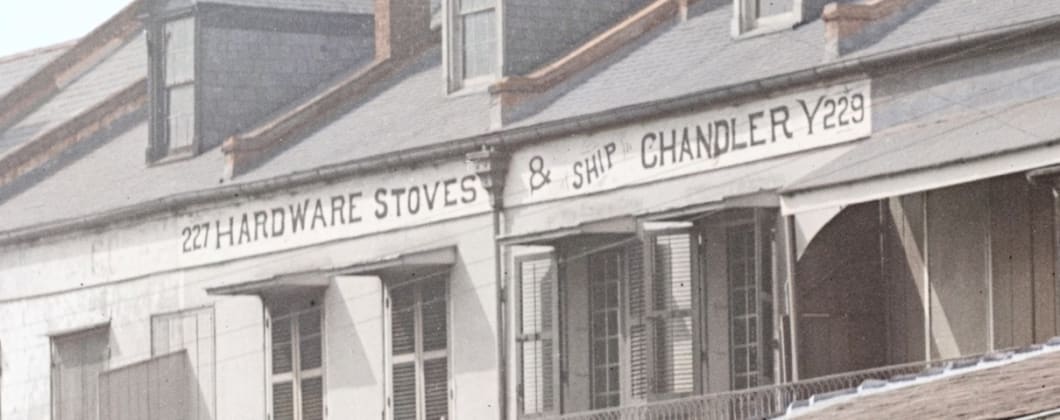
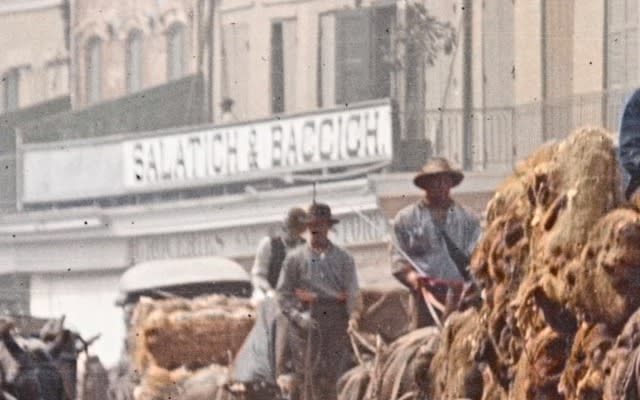
The photograph dates itself from inside the frame. Painted in one continuous band across the shopfronts on the right are the words "227 HARDWARE STOVES" and, on the building beside them, "& SHIP CHANDLERY 229." New Orleans changed to its present hundred-block street numbering in the early 1890s, and numbers in the 220s belong to the older system; read against the conversion table kept by the New Orleans Public Library, those two shopfronts fall in what is now the 900 block of Decatur Street.2 That is a reading of the painted numbers, not a statement from the archive. Across the street a long board carries the name Salatich & Baccich, a grocery and commission house whose partnership had ended by the middle of the same decade.3 Painted signs outlive the firms that pay for them, so neither detail is proof on its own. Both point to the earlier part of the bracket the Library gives, 1880 to 1897.1
The market itself is the oldest of its kind in the United States.8 A market was built on this ground in 1791, and the oldest structures standing there date to about 1813, when the building went up as the city's meat market.84 By the time this plate was exposed the market was not one building but several: the old meat market, a vegetable market built in two phases from the 1820s, the Red Stores, and a bazaar market added around 1872, the whole run under city rules for stallholders and sanitation.4 This picture is not about any of those buildings. It is about what fed them, arriving by mule cart before most of the city was awake.

The signs also record who was doing the selling. Salatich & Baccich were Dalmatian; Blaise Peter Salatich came to New Orleans from Ragusa on the Adriatic, today Dubrovnik, as a young man, clerked in a mercantile house, and then set up on his own.3 By the 1890s the market had a pronounced Sicilian character as well.6 Sicilian immigrants worked the stalls, came to dominate the city's fruit trade, handled the unloading at the docks where that fruit arrived, and built import houses of their own.6 The market's reputation as a place where several languages crossed a single counter was not decoration; it was the ordinary condition of this block. It was not a safe one. Eleven Italian men were lynched in New Orleans in 1891, inside the years this photograph could have been made.6
Under its roof every language is spoken.
The infrastructure in the frame is the working end of a riverfront system. The roadway is laid in stone setts, wet and reflective in places, with a deep open gutter and a granite curb along the left side and a plank thrown across it for anyone on foot. A heavy wooden utility pole stands in the left foreground and carries a bracket and wires out across the street. Electric arc lighting had reached the Quarter's riverfront by 1882, though what those particular wires carried cannot be told from the plate.5 A short walk behind the camera lay the levee, where Lugger's Landing took in the small boats bringing oysters and other market goods and a wide wooden wharf carried carts, dray horses, laborers, stevedores and traders.5 The ship chandlery lettered on the building opposite was selling to vessels tied up within sight of its own front door.
Not all of this was as old as it looks. The bazaar market had been added to the complex around 1872, and the arc lighting on the riverfront dated to 1882.45 What the camera found was not a picturesque row of stalls but an established market set inside a working warehouse and transport district, and the wagon line is the evidence for it.
The men on those wagons could not know how much of this was near its end. The riverfront that supplied them was rebuilt around them over the following generation, and the sugar refining work near the river moved out to suburban Arabi in 1912.5 On September 29, 1915, a hurricane came ashore and partly demolished the French Market.7 Between that storm, the rebuilding after it, and the renovation of 1936 and 1937, the market a visitor walks through today is not the one in this frame.8 The photograph records an ordinary morning at the start of an ordinary working day. Nothing in it suggests that any of the arrangement was temporary.
Every detail is the original photograph. Only the color is new. It is restored using modern professional digital techniques and transferred onto the scan of the original glass negative. Nothing is redrawn, sharpened, or invented.
Prints are available as premium luster posters, on canvas, and framed. Each one is made to order, produced close to where it ships, and sent with tracking. Shipping is free in the United States and the European Union. The edition is small, its size is stated on this page, and it will not be reprinted. Questions are welcome at support@pastincolor.com.
Sources
- Library of Congress, Prints and Photographs Division, catalog record for "The old French Market, New Orleans," LC-D418-8113, https://www.loc.gov/pictures/item/det1994023520/PP/
- New Orleans Public Library, City Archives and Special Collections, "Changes in Street Numbers," https://nolacityarchives.org/changes-in-street-numbers/
- Alcee Fortier, ed., Louisiana: Comprising Sketches of Parishes, Towns, Events, Institutions, and Persons, vol. 3 (1914), biography recording Blaise Peter Salatich and the firm Salatich & Baccich, https://www.lagenweb.org/orleans/bios/ST/salatichPeterB.html
- French Market Corporation, "History, French Market District," https://www.frenchmarket.org/history/
- John Magill, French Quarterly Magazine, "Down by the Riverfront in the French Quarter," https://frenchquarterly.com/history/down-riverfront-french-quarter
- Emily Perkins, The Historic New Orleans Collection, "Coming to New Orleans, Part III," https://hnoc.org/publishing/first-draft/coming-new-orleans-six-items-tell-story-immigration-between-civil-war-and
- NOAA Atlantic Oceanographic and Meteorological Laboratory, "100th Anniversary of the Great New Orleans Hurricane," https://www.aoml.noaa.gov/hurricane_blog/100th-anniversary-of-the-great-new-orleans-hurricane/
- New Orleans Historical, "French Market," https://neworleanshistorical.org/items/show/1395
- The Picayune's Guide to New Orleans, The Daily Picayune, 1900, https://archive.org/download/picayunesguideto00unse_0/picayunesguideto00unse_0.pdf
Opens October 30. Register above for first access.


