Historical photographs, researched and restored in full color
The past was never black and white.
The people in old photographs feel far away because we only know them in gray. They were not far away. The streets they built are the streets we walk, and the world they were making is the one we live in. We find their photographs in the public archives, give back the color the camera could not keep, and research each one until its story can be told and checked.
Why we do this
The people in these photographs were building the world we live in.
They went to work. They fed cities before dawn, ran the streetcars, raised the wharves and the storefronts, and most of them never had their names written down. Their years survive on glass plates in public archives, catalogued, digitized, and mostly unseen.
We bring those photographs back. The color is restored carefully and from the record, using modern professional digital techniques, onto the original scan, so every grain of the plate survives and nothing is invented. Then comes the slower work: reading the plate under magnification, following every painted sign and every date into the sources, until the story behind the photograph can be told and checked. The color fills in what the camera could not keep. The research fills in the rest.
We do this because the past deserves to be seen the way it was lived, in color, by people with trades and names and arguments, and because a place you know looks different once you have seen who built it. Our heritage runs further back than we usually remember. It is worth being proud of, and it is worth getting right.
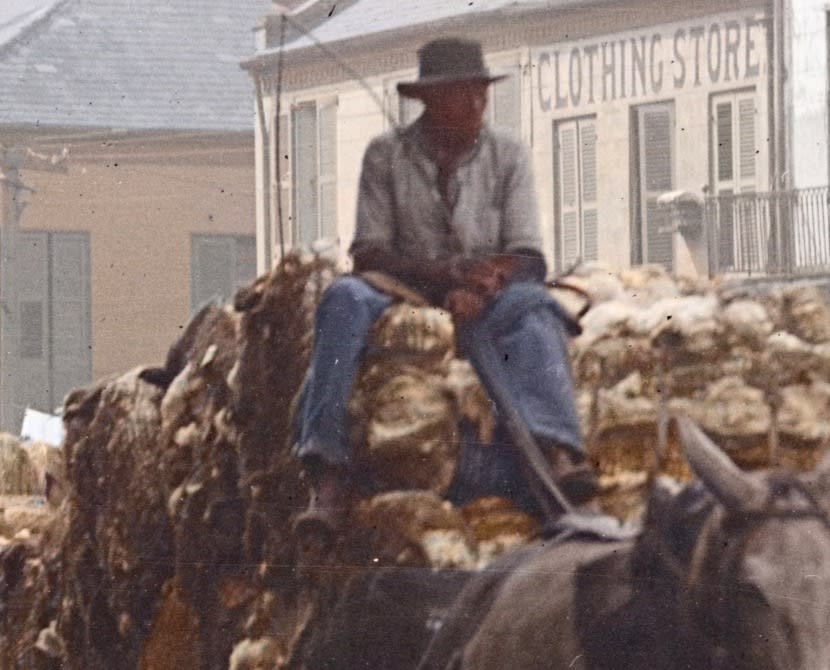
One example, from the current collection
Everything in this picture is evidence.
Before a photograph goes any further, we read it at full size and write down only what is actually there. This plate was sold as a souvenir view of the French Market in New Orleans. Here is what it told us.

-
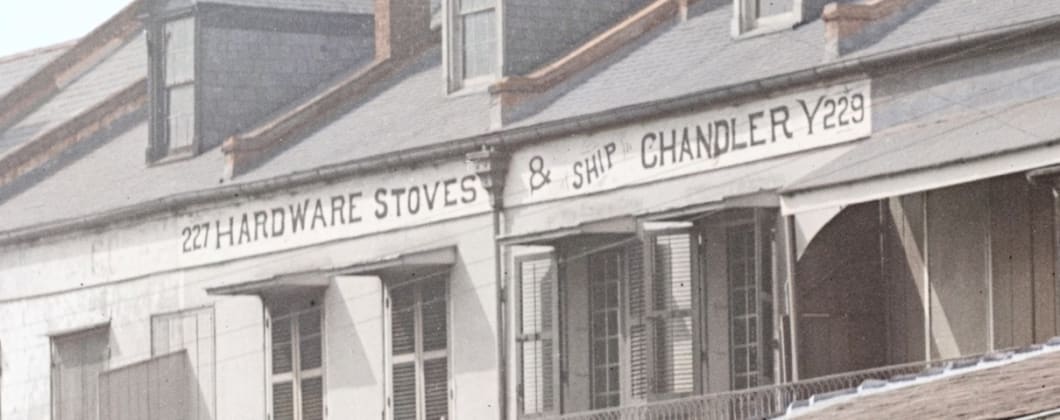
The frame dates itself.
Painted across the shopfronts on the right: 227 HARDWARE STOVES and SHIP CHANDLERY 229. New Orleans changed to its present hundred-block numbering in the early 1890s, so these numbers belong to the old system, and they place the buildings in what is now the 900 block of Decatur Street.
-

Painted signs outlive the firms that pay for them.
Across the street, a board carries the name Salatich & Baccich, a grocery and commission house whose partnership had ended by the middle of the decade. With the street numbers, it points to the earlier part of the bracket the Library gives, 1880 to 1897. We do not narrow the date further than the record allows.
-

The record is on the glass itself.
Along the bottom margin, lettered into the negative: 8113, The Old French Market, New Orleans, Detroit Photographic Co. That number matches the Library of Congress record for the plate, which attributes it to William Henry Jackson and has held it since 1949. Every claim on the print's page carries a source you can follow.
The market these wagons fed is the oldest of its kind in the United States. Read the whole story on the print's page.
New Orleans, 1900
-
Plate 6
Canal Street at Godchaux's, New Orleans, 1907
Car 181, built in St. Louis in 1899, outside a store whose family would leave this corner within a generation.
Regular price From €90,00 EURRegular price -
Plate 2
Orleans Street, New Orleans, c. 1890
In 1831 the city closed this section of Orleans Street for good.
Regular price From €115,00 EURRegular price -
Plate 4
Jackson Square, New Orleans, 1900
A tourist view recorded an argument the city had not settled.
Regular price From €90,00 EURRegular price -
Plate 5
The City from Algiers, New Orleans, 1900
A wharf coming apart plank by plank, a year before a public board took the riverfront over and rebuilt it.
Regular price From €115,00 EURRegular price -
Plate 3
Canal Street from the Clay Monument, New Orleans, c. 1890
This view cannot be made today, because the monument came down in 1901.
Regular price From €115,00 EURRegular price -
Plate 1
The Old French Market, New Orleans, c. 1890
The oldest market of its kind in the United States, fed by mule cart before most of the city was awake.
Regular price From €115,00 EURRegular price


The first collection
New Orleans, 1900 opens in
Everyone on the list receives an access code the morning the collection opens. We only write when something is ready.
These emails are about this collection only. Want to hear about every future collection too?
New Orleans, 1900 is open
Each photograph is printed in a limited edition. When the edition closes, the photograph moves to the archive and is not reprinted.
See the collectionThe next collection
The list hears first, with an access code the morning it opens.