
Plate 2
Orleans Street, New Orleans, c. 1890
Opens October 30.
Register for first access.
These emails are about this collection only. Want to hear about every future collection too?
This street ends in trees because the city ended it. In 1831 New Orleans bought the narrow strips of ground on both sides of Orleans Street and closed that section of the roadway; by 1848 the space had passed to the Cathedral trustees, who enclosed it as a private garden.2 The camera looks down a street that was deliberately stopped.

The roadway is cobbled and crowned high in the middle, with deep granite curbs and open gutters on both sides. On the left, a two-story building carries a cast-iron gallery on each floor, the railings worked in a lacework pattern. Low Creole cottages run along the right, their shutters louvered and their granite steps set down to the sidewalk. At the far end stand the trees of St. Anthony's Garden, and behind them the rear of the Cathedral of St. Louis, its pediment carrying a round clock face and the central spire rising above. The Library of Congress catalogs the plate only as "Street in New Orleans near cathedral," with a publisher's stock number in place of an address.1 That commercial indifference is exactly why the picture works as evidence. The photographer recorded the block as he found it, and left the rest to us.
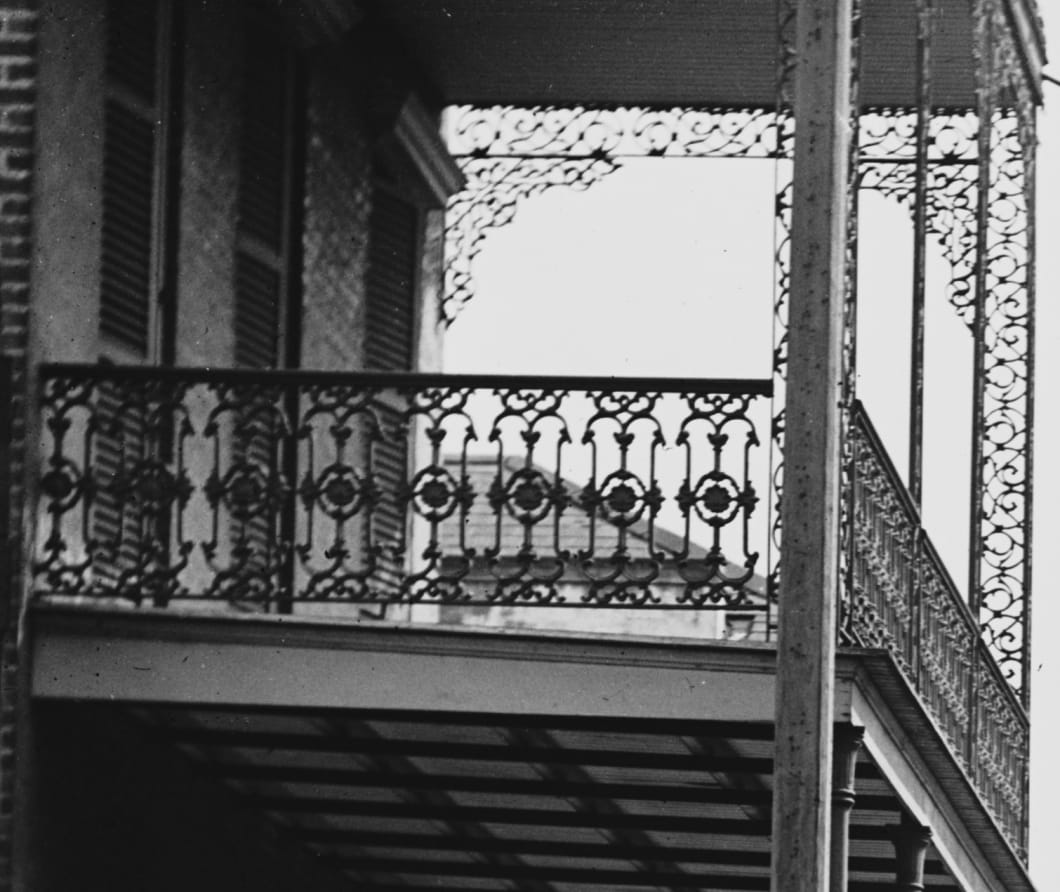
Story above story the balconies climb upward, till the house-front is veiled in iron lace; while at the banquette edge, stair-flights are guarded by wrought-iron gates, and high in the steep gable ends long fan windows look out from behind iron guards.
The ground behind that wall of green had already served as a Capuchin kitchen garden, as a dueling place, and as shelter for people burned out of their homes.2 What closed the street was a municipal land transaction completed roughly forty years before the exposure, and the garden it produced still separates this block from the cathedral today.
The buildings on either side are ordinary housing in a district that photographs as grand. The Quarter of this period was built of Creole cottages, galleried townhouses, courtyards and iron balconies, and a great deal of it was rented.3 A cottage of about 1835 documented on Toulouse Street had four rooms around a central chimney, worked as rental property, and at times held as many as ten occupants.4 Read the low roofs on the right of the frame with that number in mind. The people who filled such housing were not one community. Sicilian immigrants arrived in large numbers through the port after Italian unification, and by 1875 part of the Lower Quarter was known as Little Palermo, with Sicilian families prominent in the French Market fruit trade and in work along the wharves.5 They lived within a wider Creole, Black, Irish, French and American city, among Catholic institutions, immigrant commerce, crowded rentals and open prejudice. This block sits at the upper end of the Quarter rather than in that lower district, so the mixture belongs to the neighborhood and is not a claim about these particular doors.
The two largest signs in the frame are for wood, coal and ice. Those were the goods a New Orleans household bought all year round, fuel for cooking in a hot climate and ice for keeping food. The ice was local industry rather than a luxury import. The federal census of 1900 identified a New Orleans plant built in 1866 as the first important American ice factory, and recorded manufactured-ice production growing quickly through the 1880s.7 Wagons carried it out to household iceboxes across the city, and a painted board like the one on this street was the retail end of that chain.8 In a picture full of weathered stucco and old iron, the ICE sign is the most modern thing visible.

The street surface and the wires tell the same story of uneven modernity. Quarter streets in this period were paved in a mixture of cobblestone, granite, brick and shell, while the sidewalks, gutters, drainage and sanitation stayed imperfect.6 Around 1880 the city still depended largely on privies, and households drew drinking water from cisterns.6 The lamp standard at the left curb burns gas, although electric arc lighting had reached New Orleans in 1882, with wires strung across intersections and run along building fronts and beneath galleries.6 The poles in this frame carry only a handful of wires. There is no streetcar track in the roadway at all, and the citywide conversion from horse cars to electric traction did not begin until 1893.11
What sits just outside this photograph in time is a public-health emergency and its long aftermath. The yellow-fever epidemic of 1878 killed more than 4,000 people in New Orleans and disrupted the port and its commerce.9 The Auxiliary Sanitary Association formed the following year, and yet by 1880 the city still had neither a modern sewerage system nor a safe common water supply.9 After this plate was made, the fever returned in 1897 and killed nearly 300.9 The outbreak of 1905 was fought with the new understanding that mosquitoes carry the disease, and with cisterns covered against them; it was the last yellow-fever epidemic in the United States.910 Drainage came later still. Albert Baldwin Wood joined the Sewerage and Water Board in 1899, presented plans for a twelve-foot screw pump in 1913, and saw the first four installed in 1915.12
The people standing on this street could not know any of it. They could not know that the ice trade whose sign hangs above them would become a public scandal in 1902, when an alleged monopoly provoked open anger.8 They could not know that the cisterns behind their houses would be covered as a matter of public health within a decade.10 In 1896, at the late edge of this photograph's date range, the Supreme Court decided Plessy v. Ferguson, a case brought by a committee of New Orleans citizens, and set the separate-but-equal doctrine that would shape their city for two generations.13 In the same span of years, between 1890 and 1910, the music that would carry the city's name around the world was being worked out elsewhere in town.14 None of it is visible here. That is the ordinary condition of a photograph, and it is most of the reason to look at one closely.

The print is made from the Library of Congress digital file of the original glass negative, carefully restored in full color using modern professional digital techniques. Every detail is the original photograph. Only the color is new. Nothing is redrawn, sharpened, or invented.
Prints are available as premium luster posters, on canvas, and framed. Each is made to order and produced close to where it ships. Every order ships with tracking, and shipping is free in the United States and the European Union. The edition is small, the size is stated on this page, and it will not be reprinted. Questions are welcome at support@pastincolor.com.
Sources
- Library of Congress, Prints and Photographs Division, "Street in New Orleans near cathedral," LC-D418-8107, https://www.loc.gov/pictures/item/det1994023514/PP/
- The Cultural Landscape Foundation, "St. Anthony's Garden," https://www.tclf.org/st-anthonys-garden
- Preservation Resource Center of New Orleans, "French Quarter," https://prcno.org/help-for-homeowners/historic-districts-neighborhoods/french-quarter/
- The Historic New Orleans Collection, "726-28 Toulouse Street: Creole Cottage," https://hnoc.org/research-collections/our-buildings/726-28-toulouse-street-creole-cottage
- The Historic New Orleans Collection, "Coming to New Orleans, Part III," https://hnoc.org/publishing/first-draft/coming-new-orleans-six-items-tell-story-immigration-between-civil-war-and
- Preservation Resource Center of New Orleans, "Managing Streets, Utilities, and Municipal Services in Historic New Orleans," https://prcno.org/managing-streets-utilities-municipal-services-historic-new-orleans/
- U.S. Census Office, Bulletin 174, "Manufactured Ice," https://www2.census.gov/library/publications/decennial/1900/bulletins/manufacturing/174-manufactures-manufactured-ice.pdf
- The Historic New Orleans Collection, "The Big Freezy," https://hnoc.org/publishing/first-draft/the-big-freezy
- The Historic New Orleans Collection, "When Yellow Fever Forced New Orleans to Confront Its Sanitation Problem," https://hnoc.org/publishing/first-draft/late-1800s-devastating-yellow-fever-epidemics-forced-new-orleans-confront
- PBS American Experience, "Epidemic in New Orleans," https://www.pbs.org/wgbh/americanexperience/features/fever-epidemic-new-orleans/
- NewOrleans.com, "New Orleans Streetcar Guide," https://www.neworleans.com/plan/transportation/streetcars/
- American Society of Mechanical Engineers, "The A.B. Wood Low Head High Volume Screw Pump," https://www.asme.org/wwwasmeorg/media/resourcefiles/aboutasme/who%20we%20are/engineering%20history/landmarks/3-abwood-screw-pump.pdf
- Oyez, "Plessy v. Ferguson," https://www.oyez.org/cases/1850-1900/163us537
- Smithsonian Center for Folklife and Cultural Heritage, "Freedom Sounds"; National Park Service, "A New Orleans Jazz History, 1895-1927," https://folklife.si.edu/magazine/freedom-sounds-new-orleans-music-spirit-of-a-community
Opens October 30. Register above for first access.


