
Plate 5
The City from Algiers, New Orleans, 1900
Opens October 30.
Register for first access.
These emails are about this collection only. Want to hear about every future collection too?
The famous part of this view sits small and far away, and everything close at hand is timber, mud, and work. In 1900 a photographer working for the Detroit Photographic Company set up on the Algiers bank of the Mississippi and pointed the camera back at New Orleans. The photographer's name was never recorded.2 The year is not in doubt, because the copyright line is burned into the negative itself, and the Library of Congress catalogs the plate as one of the Detroit views of the city seen from Algiers.1 What the plate offers is not a view so much as a piece of evidence: a working shore in the foreground, a wide reach of open river in the middle, and a city reduced to a low line of roofs and spires beyond.
St. Louis Cathedral stands at the center of the skyline, its spire and clock face above the two lower towers, marking Jackson Square exactly. Upriver of it rises an ornamented commercial mass with a corner tower, consistent with the Jackson Brewery.2 Running across the frame in front of both is a long low wharf shed, with railway cars drawn up on the levee behind it. Those cars are the point of the photograph as much as the cathedral is.

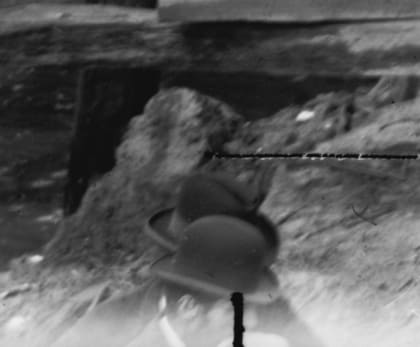
The near bank tells the other half of the story. A wooden wharf is being taken apart plank by plank on the left, deck boards lifted and stacked, joists open to the air, timber lying scattered on the mud. A steam vessel lies at a stage a few yards away with the name JOSIE on its pilothouse and someone at the wheel behind the glass. At the bottom edge of the frame, nearer than anything else in the picture, a man in a hat moved while the shutter was open and left himself as a blur. This is what a working riverfront actually looked like: continually rebuilt against a river that moved its own bed.


Algiers itself was a river-and-rail district, not a residential quarter. Its economy ran on shipbuilding, ship repair, dry docks, sawmills, lumber yards, an iron foundry, railroad yards, ferries, and a streetcar from the ferry landing toward Gretna.46 Railroad cars were ferried across the river here, and the site that later became a naval station began as a dry dock.7 The work drew African American laborers and immigrants from Italy, Germany, and Ireland into the shipyards, the stockyards, and the railroads.6 The ferry carried them across to the French Quarter and downtown, and the district kept its own shops, churches, schools, bars, and dance halls; by 1911 the neighborhood reportedly counted between thirty-six and thirty-nine bars.6
Five years before this plate, much of that neighborhood burned. The Great Algiers Fire of October 20 and 21, 1895 began in a crowded tenement, ran through wooden housing and stored fuel, destroyed roughly ten blocks and nearly two hundred houses, took the courthouse, and displaced about twelve hundred people.54 Contemporary accounts record how little the wells, pumps, and hoses could do against it.5 Rebuilding was fast. Streets were paved, electric service and a new waterworks arrived, a viaduct went in, and new Victorian and shotgun houses replaced much of what had been lost.46 The camera in this photograph stands in a neighborhood that had just been made again.
The wharves across the water were about to be made again too. In 1896 the Louisiana Legislature created the Board of Commissioners of the Port of New Orleans, but an existing lease kept the wharf system in private hands.3 Before the Board took over, only a few wharves had protective sheds at all, which is why the single long shed in this frame is worth noticing.3 The lease expired on May 29, 1901, within a year and a half of this exposure.3 Within seven years the public system had been substantially rebuilt with heavy timber wharves on creosoted piles and modern steel sheds, and a statute of 1908 authorized three and a half million dollars in bonds to keep the work going.3 By the early 1920s the docks ran to miles of permanent wharf, covered shed space, electric traveling cranes, electric trucks, escalators, and banana conveyors.3 The loose, open, wooden riverfront in this photograph had perhaps a decade left.
The people on this bank could not know any of it. They could not know that the lease would lapse the following May and hand the whole waterfront to a public board. They could not know that Algiers would receive a United States Naval Station in 1901.7 They could not know that in 1905 the last yellow-fever epidemic in the United States would begin near this river, among the Italian immigrant workers who unloaded the banana boats.8 What the photograph holds is the ordinary day before all of that: one boat, one broken wharf, and a cathedral on the far side of the river.
Each print is made to order and carefully restored in full color using modern professional digital techniques. Every detail is the original photograph. Only the color is new; nothing is redrawn, sharpened, or invented.
Prints are available as premium luster posters, on canvas, and framed, and each one ships with tracking. Production happens close to where the print ships. Shipping is free in the United States and the European Union. The edition is small, the size is stated on this page, and it will not be reprinted. Questions are welcome at support@pastincolor.com.
Sources
- Library of Congress, Prints and Photographs Online Catalog, [The City from Algiers, New Orleans, Louisiana], https://www.loc.gov/pictures/item/2016800690/
- Wikimedia Commons, File:AlgiersToJacksonSquareNOLADetroitSeries.jpg, https://commons.wikimedia.org/wiki/File:AlgiersToJacksonSquareNOLADetroitSeries.jpg
- John Kendall, History of New Orleans, Chapter 38, https://penelope.uchicago.edu/Thayer/E/Gazetteer/Places/America/United_States/Louisiana/New_Orleans/_Texts/KENHNO/38*.html
- William H. Seymour, The Story of Algiers, 1718-1896, https://www.buhler-family.net/Library/TheStoryOfAlgiers/TheStoryOfAlgiers.pdf
- Preservation Resource Center of New Orleans, "The Great Fire of 1895", https://prcno.org/great-fire-1895/
- Preservation Resource Center of New Orleans, "Algiers Point", https://prcno.org/help-for-homeowners/historic-districts-neighborhoods/algiers-point/
- The Historic New Orleans Collection, "The Overlooked History of Algiers Point as Seen from the Levee", https://hnoc.org/publishing/first-draft/walk-along-levee-and-catch-view-overlooked-history-algiers-point
- PBS American Experience, "Epidemic in New Orleans", https://www.pbs.org/wgbh/americanexperience/features/fever-epidemic-new-orleans/
Opens October 30. Register above for first access.


