
Plate 4
Jackson Square, New Orleans, 1900
Opens October 30.
Register for first access.
These emails are about this collection only. Want to hear about every future collection too?
The sharpest sentence in this photograph is cut into stone. On the river-facing side of the pedestal at its center the monument reads "THE UNION MUST AND SHALL BE PRESERVED," words a Union general ordered carved into the central square of a Confederate city.2 In 1900 the Detroit Photographic Co. set a camera inside Jackson Square to make a tourist view, and recorded, in passing, an argument the city had not settled.1

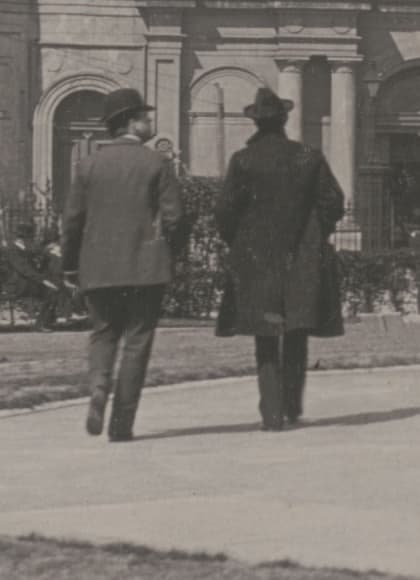
The view looks inland toward the Cathedral of St. Louis, from the river side of the walk. The Cabildo stands to the left of the cathedral, the Presbytere to the right. Clark Mills' equestrian statue of Andrew Jackson rises in the middle distance, the horse rearing and Jackson raising his hat. Two men walk away from the camera along the gravel path, one in a suit and bowler, the other in a long heavy overcoat and a soft felt hat. Figures rest on a bench inside the fence line. The planting beds beside the path are bare earth with dormant stems, and utility poles and overhead wires cross the sky at the right of the frame.
This was not an empty colonial plaza. By 1900 the square was an established ceremonial park, with ornamental iron fencing, formal gardens, gravel paths and benches set around the monument at its center.3 Most of that arrangement dated from the early 1850s, when Micaela Almonester, Baroness de Pontalba, built the two long red-brick blocks that flank the square (1849 to 1851) and the ground took its formal garden shape.6 The ground itself was older and heavier. It had been the Place d'Armes of French colonial New Orleans and the Plaza de Armas under Spanish rule, and the transfer of Louisiana to the United States was completed in 1803 at the Cabildo on its edge.6 The parade ground was renamed for Andrew Jackson in 1851, and Mills' statue was dedicated on 9 February 1856.106

The words on the pedestal are not original to the monument. They were carved during the federal occupation of New Orleans in the Civil War, by order of General Benjamin Butler, who adapted a toast Jackson had given in 1830 into something flatter and more pointed.2 By the time this negative was made, the sentence had stood there for nearly forty years. It is still there.
The neighborhood around the frame was working-class and changing fast. Creole families had been moving out toward Esplanade and Uptown, and Sicilian immigrants were taking subdivided rooms in what had been mansions.5 The lower Quarter was already known as "Little Palermo" by 1875.5 Sicilian families ran stalls in the French Market a short walk from this path, managed the unloading of fruit at the wharves, and built import businesses out of that trade.5 The same years carried severe hostility toward them, including the lynching of eleven Italian men in 1891 after the Hennessy case.5 The Pontalba blocks on either side of the square had lost their wealthy tenants after the Civil War, and a later preservationist remembered poverty and decay over the whole Quarter, with tattered clothing hanging on the balconies of what had been a fashionable address.3
The wires at the right of the frame belong to a city that had recently rebuilt how it moved. Street railway routes ran past Jackson Square and the French Market as early as an 1884 guide to the system, and in 1893 electric cars replaced the horse-drawn ones across New Orleans.9 The poles and lines in this photograph are the visible edge of that change, though the record does not allow any single wire here to be traced to a particular service. Behind the camera, out of frame, the riverfront had changed as well: in 1896 the open wooden wharves were replaced by covered sheds, which obstructed the views between the Quarter and the river.8
Other changes came just before and just after the shutter. A fountain had been installed inside the square in 1895.7 In 1903 the square was used for the centennial of the Louisiana transfer, and in 1915 for the centennial of the Battle of New Orleans.7 Artists and writers began settling around it during and just after the First World War, drawn by cheap rents and faded architecture.4 In 1919 the president of the Association of Commerce proposed converting the Pontalba buildings into studios and living space for artists.4 The Pontalba property was sold in 1920, and by that decade the revival taking hold here was being called the Renaissance of the Vieux Carre, in a neighborhood still full of tenements and failing buildings.34
None of that was available to the two men on the path. They were walking through a district that respectable opinion had largely written off, two decades before it turned fashionable and tourist-oriented. The cheap rents and faded architecture that marked the Quarter as a failure in their day were the very things that drew the artists and writers who helped save its buildings.
The print is made from the Library of Congress master scan of the original, carefully restored in full color using modern professional digital techniques. Every detail is the original photograph. Only the color is new. Nothing is redrawn, sharpened, or invented, so the caption along the bottom margin, the 1900 copyright stamp, and the lettering on the pedestal all remain exactly as they are on the original.

Prints are available as premium luster posters, on canvas, and framed, made to order and produced close to where they ship. Every order ships with tracking. Shipping is free in the United States and the European Union. The edition is small, the size is stated on this page, and it will not be reprinted. Questions are welcome at support@pastincolor.com.
Sources
- Library of Congress, Prints and Photographs Division, "Jackson Square & Cathedral of St. Louis, New Orleans," LOT 9093-B, LC-DIG-ppmsca-53304, https://www.loc.gov/pictures/item/2017658694/
- Mary Ann Wegmann, "Jackson Square during the Battle of New Orleans," New Orleans Historical, https://neworleanshistorical.org/items/show/623
- Hilary Irvin, "Pontalba Buildings," 64 Parishes, Louisiana Endowment for the Humanities, https://64parishes.org/entry/pontalba-buildings
- John Shelton Reed, "French Quarter Renaissance," 64 Parishes, Louisiana Endowment for the Humanities, https://64parishes.org/entry/french-quarter-renaissance
- Emily Perkins, "Coming to New Orleans, Part III," The Historic New Orleans Collection, https://hnoc.org/publishing/first-draft/coming-new-orleans-six-items-tell-story-immigration-between-civil-war-and
- National Park Service, "Place d'Armes (Jackson Square)," https://www.nps.gov/places/places-darmes.htm
- "Jackson Square," French Quarterly Magazine, https://frenchquarterly.com/history/jackson-square
- "Our Riverfront, Past and Present," French Quarterly Magazine, https://frenchquarterly.com/history/our-riverfront-past-and-present
- "New Orleans Streetcar Guide," NewOrleans.com, https://www.neworleans.com/plan/transportation/streetcars/
- The Historic New Orleans Collection, "From Soldiers to Statues: a Brief History of Jackson Square," https://hnoc.org/publishing/first-draft/brief-history-jackson-square-soldiers-statues
Opens October 30. Register above for first access.


